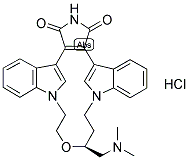
Molecular Weight: 505.01
Molecular Formula: C28H28N4O3.HCl
Canonical SMILES: CN(C)CC1CCN2C=C(C3=CC=CC=C32)C4=C(C5=CN(CCO1)C6=CC=CC=C65)C(=O)NC4=O.Cl
InChI: 1S/C28H28N4O3.ClH/c1-30(2)15-18-11-12-31-16-21(19-7-3-5-9-23(19)31)25-26(28(34)29-27(25)33)22-17-32(13-14-35-18)24-10-6-4-8-20(22)24;/h3-10,16-18H,11-15H2,1-2H3,(H,29,33,34);1H/t18-;/m0./s1
InChIKey: NYQIEYDJYFVLPO-FERBBOLQSA-N
Purity: > 95%
Solubility: Soluble to 20 mM in DMSO
Application: Enzyme Inhibitors
Storage: Store in a cool and dry place and at 0 - 4°C for short term (days to weeks) or -42°C for long term (months to years).
Synonyms: Ruboxistaurin Hydrochloride; LY-333531 hydrochloride; Ruboxistaurin (hydrochloride); 169939-93-9; LY 333531 hydrochloride; LY333531 hydrochloride; Ruboxistaurin-d6 Hydrochloride; 169939-94-0 (base);
DescriptionRuboxistaurin, also called as LY 333531, initially developed for the treatment of diabetic retinopathy, inhibits isolated enzymes PKCβI and PKCβII with a half-maximal inhibitory constant of 4.5 and 5.9 nM, respectively. The half-life of ruboxistaurin, which can be orally administered, is approximately 9h and that of its metabolite 16h, therefore allowing once-daily dosing. Based on data from clinicalTrials.gov, Children's Hospital Medical Center, Cincinnati plan a phase I/II trial of the effect of ruboxistaurin for its safety, tolerability, and effectiveness in treating adult patients with heart failure on June 9, 2016.
More details are to be found on
supplier website